



ClimateMaster Geothermal Heat Pumps
In order to dissipate or capture heat for the water loop, the "Boilerless/Towerless" Heat Pump systems use the natural thermal properties of the Earth. Geothermal Heat Pumps operate in the same way as Water-Source Heat Pump units. They are saving important energy costs and space, without the need of a boiler or cooling tower. The units are located inside the building and the water loop system is below ground level. In this way, the environmentally friendly geothermal system maintains the architectural design of a building in the natural manner.
Geothermal Earth Loops
Depending on space availability and soil properties, Geothermal Earth Loops are presented in several various configurations. You might have at some point either stood over, or walked across a geothermal loop field. The locations of loop fields can be under parking lots, landscaped areas, or different other locations. High-density polyethylene pipes are used in earth loops in order to circulate either water or an antifreeze mixture. In order to prevent leaks, all joints and connection fittings are thermally fused and most piping comes with a 25-year or longer warranty.
Vertical Loops

Bore holes drilled to an average depth of 250 feet are used for vertical loops. For maximum thermal conductivity, after the loop pipe is inserted, the borehole is gouted with a Bentonite mixture. When there is little room, the most common type of geothermal loop installed are vertical loops.
Horizontal Loops
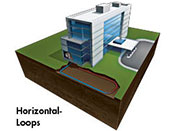
Trenches dug to an average depth of four to six feet are used for horizontal loops. Horizontal loops are commonly found in open fields, parks or under parking lots as they are one of the more cost effective loops to install.
Lake Loops

A "slinky" assembly of geothermal loop piping located at the bottom of a pond, lake, or other large body of water is used for lake loops. If the option is available, lake loops are an easy alternative as they are an extremely cost effective loop system.
Open Loop (Well)
Largely known as "Open Loop", well systems pump water out of a nearby body of water or water well, and then discharge the water into another body of water or water well. In order to keep the building water loop separated from the well water, well systems normally employ a plate heat exchanger inside the building. This extends system life and the unit performance is not affected by any contaminates. The well water is always at the same temperature during all seasons and that often makes well systems the most efficient.
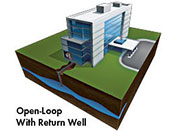
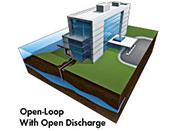
 Documentatii pentru Pompe de caldura
 ClimateMaster Movie
For details and information please contact us and check out: www.climatemaster.com